Gurgaon

Artist profile
Satyanarayana Gavara
Satya studied printmaking at Andhra University, Visakhapatnam, followed by an MFA in Printmaking from the Maharaja Sayajirao University of Baroda. The politics and materiality of food sit at the centre of his practice for the most personal reason possible: born into a family of tenant farmers, he has watched his family live them.
Biography
Satya studied printmaking at Andhra University, Visakhapatnam, followed by an MFA in Printmaking from the Maharaja Sayajirao University of Baroda. The politics and materiality of food sit at the centre of his practice for the most personal reason possible: born into a family of tenant farmers, he has watched his family live them. His prints render the everyday objects and rituals of rural Indian life as metaphors for the conditions that shape them: landlord systems, economic policy, the unpredictability of weather and yield, the resilience and the loss.
Read full biography
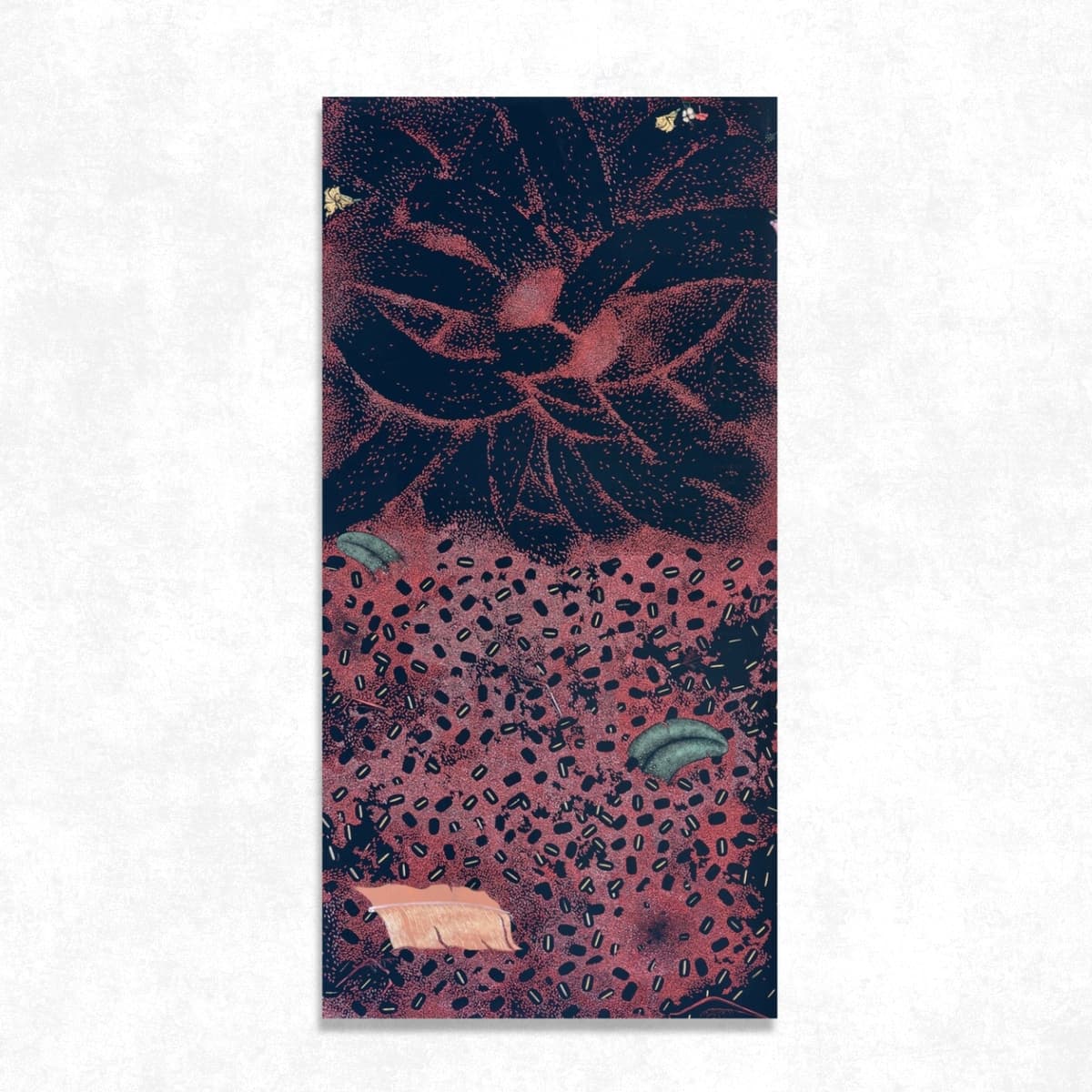
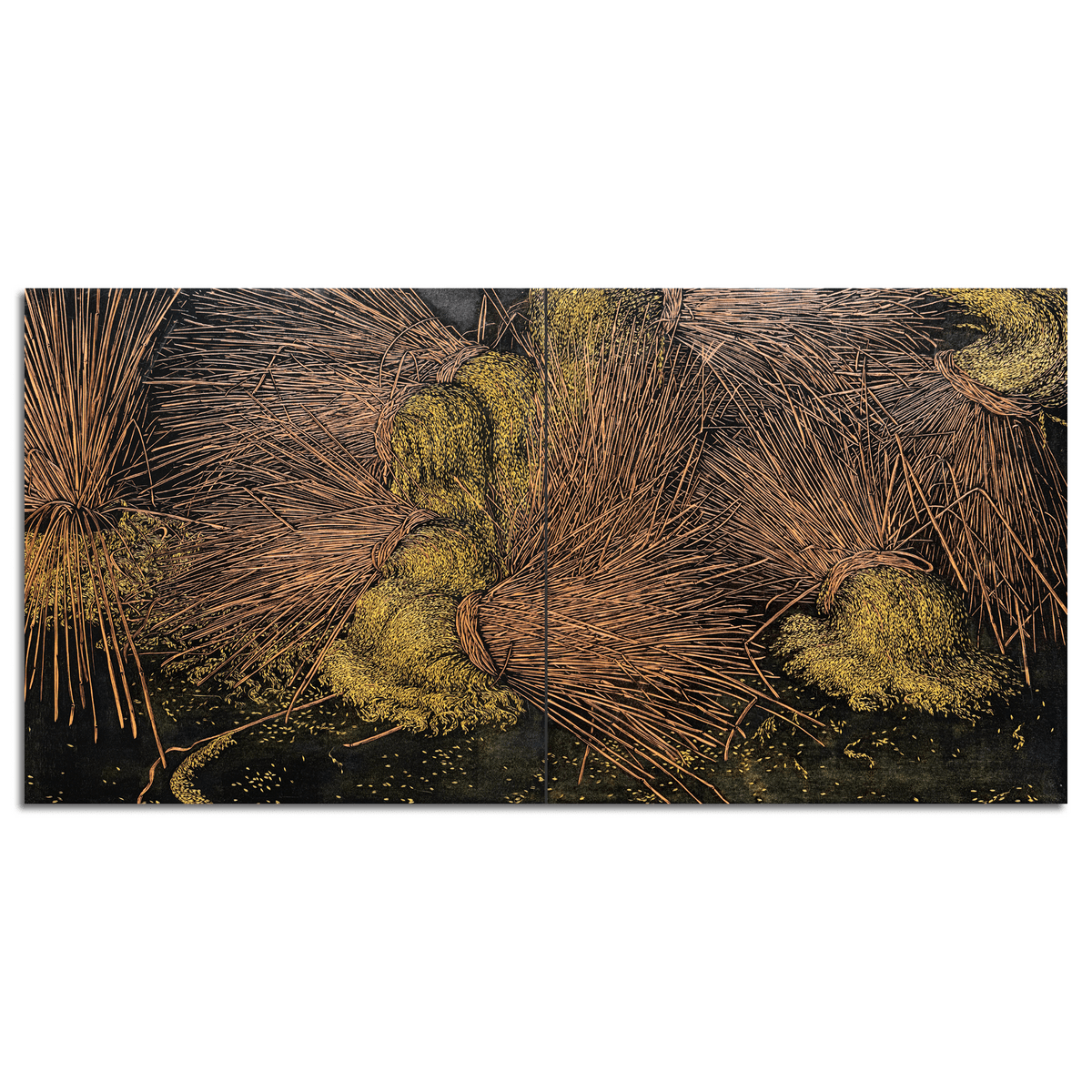
Satya studied printmaking at Andhra University, Visakhapatnam, followed by an MFA in Printmaking from the Maharaja Sayajirao University of Baroda. The politics and materiality of food sit at the centre of his practice for the most personal reason possible: born into a family of tenant farmers, he has watched his family live them. His prints render the everyday objects and rituals of rural Indian life as metaphors for the conditions that shape them: landlord systems, economic policy, the unpredictability of weather and yield, the resilience and the loss. He works principally in woodcut, alongside watercolour, etching and drawing, choosing the slowest and most physically demanding of the printmaker’s techniques to speak about labour, land and the body. The lineage he draws from is precise and explicitly cross-cultural. From India: Nandalal Bose’s introduction of graphic art at Kala Bhavan in the 1920s, and Haren Das’s monochrome bucolics of rural Bengal. From Europe: Dürer’s engravings, Goya’s Disasters, Käthe Kollwitz’s working-class testimony, and Anselm Kiefer’s archival weight. The conceptual scaffolding comes from Lévi-Strauss and Roland Barthes on food as cultural communication, a system of meaning with its own grammar, applied to ritual specificities that are entirely his own: Waralu seeds soaked in goat’s blood, burnt rice straw dusted across the harvest mound to ward off theft, the unequal division of crops he depicts in Intelligence of Innocence. Recent works mark a shift from figuration toward the symbolic. In the Anecdotes series, food becomes a totemic presence, void of human interference, commanding the narrative. The medium itself has shifted in parallel: where Satya once carved his woodblocks as plates from which to pull prints, the blocks themselves are now the works, meticulously incised and filled with colour, the matrix presented as the finished object rather than the tool that made one. A Journey Through A Granary, engraved and oil-painted on wood at architectural scale, makes this register explicit. For an exhibition gathered around craft as contemporary language, his work makes the argument unanswerable: an exact rhyme with the long European tradition of woodcut as a rural-political medium, made urgent again from inside a country where roughly three-quarters of the population still belongs to the rural region. In 2026 he was named one of Art India Magazine’s 30 Under 30. Recognition: Art India Magazine, 30 Under 30, 2026. Selected exhibitions and fairs: Art Mumbai, 2025; Paris (with 193 Gallery), 2025 and 2026; curated group shows at Vadehra Art Gallery, New Delhi, and Method, Mumbai; CIMA Art Award Show, Kolkata, 2022; 55th Annual Exhibition, Birla Academy of Art & Culture, Kolkata, 2022; Second International Mini Print Triennial, Ukraine, 2021; SYPA, Bangladesh, 2019; Tokyo International Mini Print Triennial, Japan, 2018. Residencies: Khoj International Artists’ Association, New Delhi; Space Studio Summer Residence, Baroda; Immerse Residence, Mumbai. Commissions: Site-specific large-scale installation, reception of a luxury hotel, Madurai.